Inside the article
Request a product demo
Get a demo and clarify your doubts about our software.
Key Takeaways
- The global container storage and rental market is estimated to be valued at approximately USD 13.99 billion in 2026 and is growing at 5.8 percent annually. Demand is being pulled by e-commerce, construction, and modular retail.
- A 20-ft container rents for $100-$150 per month. A 40-ft unit brings $175-$250. Delivery fees add $150-$300 per trip. The math works, but only if you control your costs.
- 2026 US tariffs on steel imports have pushed the price of new containers up meaningfully. Used units are now the smarter starting point for most first-time operators.
- Most container rental businesses reach positive cash flow within 12 months. Net margins for well-run operations typically land between 10 and 25 percent.
- Spreadsheets and phone calls work for two or three containers. They do not work for ten. The operators who scale fastest are the ones who switch to software before they need to, not after.
What is a container rental business, really?
The basic idea is straightforward. You buy steel containers, you rent them to people who need space, and you collect monthly income. The appeal is real - containers are durable, in demand, and relatively low maintenance compared to most physical assets. But the business rewards people who understand the logistics, not just the math.
How the container rental model actually works
You own the container. A customer needs it on their property - a construction site, a farm, a retail lot, a residence during a renovation. They pay you a monthly fee plus delivery and pickup charges. The container sits, earns money, and comes back to you when the rental ends.
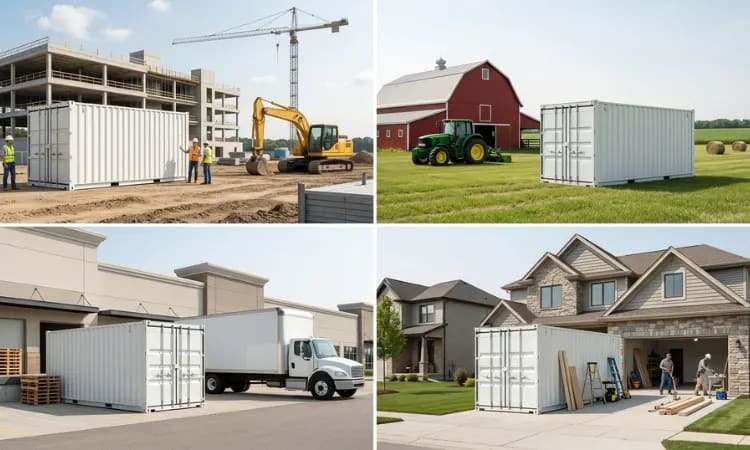

A comparison of typical rental environments, including construction, agriculture, retail, and residential projects. AI-generated illustration for explanatory purposes.
Unlike most rental businesses, you are not renting something that moves or wears out from use. A well-maintained container in your fleet today will still be earning money in fifteen years. That durability is what makes the model attractive. The margin on each unit grows over time as the original purchase cost gets paid off.
Storage containers vs. shipping containers (people mix these up constantly)
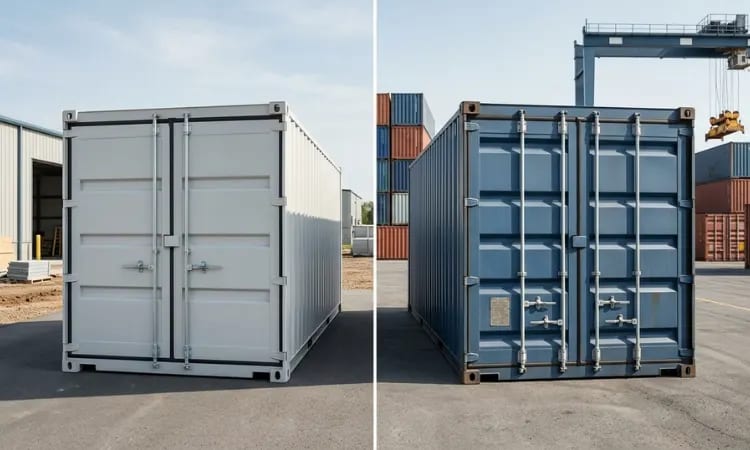
A visual comparison between portable storage containers and shipping containers. AI-generated illustration.
This distinction matters more than most people expect. Shipping containers are built to international ISO standards and designed for ocean freight. They have standardized dimensions, corner castings for stacking, and they can be repositioned via crane. Storage containers are often similar in structure but sold or rented as static storage solutions without the expectation of frequent relocation.
Which one should you rent out first?
In practice, the containers most rental operators use are former shipping containers repurposed for storage. They are structurally the same product. The distinction is in what the customer expects to do with it.
Start with containers in 20-ft and 40-ft sizes. They are the most requested, the easiest to source, and the most transportable with standard flatbed equipment. Specialty units - refrigerated containers, office containers, modified units with shelving or electrical - come later, once you have a base of steady customers and know what your local market actually asks for.
Office and refrigerated units can rent for $500-$1,000 per month, which is tempting. They also come with higher purchase costs, more maintenance complexity, and a narrower customer pool. Build your core fleet first.
Is a container rental business actually profitable?
Yes. But profitability depends heavily on two things: utilization and delivery cost control. A container sitting empty in your yard is not an asset. It is a liability.
How the money actually comes in
A 20-ft container renting at $130 per month generates $1,560 per year. Add a delivery fee of $200 and a pickup fee of $200, and a single rental cycle brings in $1,960.
The global container storage and rental market is estimated to be valued at approximately USD 13.99 billion in 2026 by Business Research Insights. For operators who maintain high utilization rates, the model compounds well over time.
The sweet spot is recurring long-term rentals. A customer who keeps a container on their property for eighteen months is far more valuable than three customers who each rent for six months. Long-term contracts reduce your delivery costs, stabilize your revenue, and give you a cleaner view of available inventory at any given time.
What quietly eats into your margins
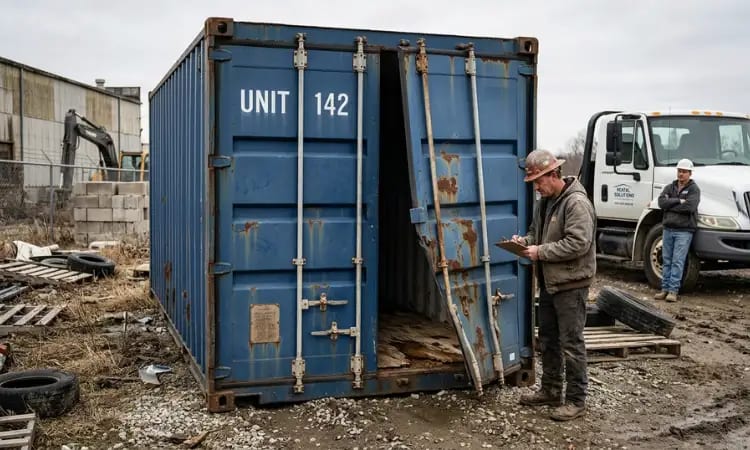
A container showing the impact of delivery challenges and maintenance issues. AI-generated illustration.
Delivery is the biggest variable most new operators underestimate. A delivery that takes longer than expected, requires special equipment, or lands on a difficult site can turn a profitable booking into a breakeven one. Fuel costs, driver time, and equipment wear all belong in your per-delivery calculation, not as a general overhead estimate.
Containers also degrade faster than people assume if maintenance is neglected. A rusting door that does not seal, damaged flooring, or a compromised roof can cost $500-$1,500 to fix and takes a unit out of circulation while the work is done. Catching problems between rentals is cheaper than fixing customer complaints.
How to start a container rental business
Figure out who actually needs containers near you
Before you buy anything, spend a week making phone calls. Call contractors in your area and ask what storage solutions they use and what they pay. Drive industrial areas and note which businesses have containers on site - those businesses are already customers for someone. Talk to real estate developers, event companies, retailers doing seasonal inventory, and agricultural operations.
The goal is to understand whether local demand is consistent enough to support a fleet. A rural area with three active construction companies is a smaller market than a suburb with a dozen contractors and two growing industrial parks. Know your market before you commit capital.
Pick your container types and sizes
20-ft and 40-ft standard steel containers cover the majority of what customers ask for. A 20-ft unit fits on most residential driveways and smaller commercial lots. A 40-ft unit is the go-to for contractors and businesses needing more volume. Start with more 20-ft units than 40-ft - they are easier to place and move more frequently.
Resist the urge to diversify your fleet early. Every additional container type adds purchasing complexity, maintenance knowledge requirements, and storage considerations. Simplicity is an advantage when you are getting started.
The zoning and land problem nobody warns you about
Most new operators discover this one after they have already bought their first containers. Local zoning laws often regulate where containers can be placed - on customer sites and on your own storage land. Residential zones may prohibit them outright. Commercial zones may allow them only in specific configurations. Some municipalities require permits for containers that stay on a site longer than a certain number of days.
Before you sign a lease on storage land or take your first booking, spend a few hours with your local zoning office. Ask what permits are required for container placement, what signage or screening rules apply, and whether there are any restrictions on how many units can be stored on a single property. The answers will save you expensive problems later.
Read the complete guide on Shipping Container Zoning Laws in All 50 States
Register the business and get the boring paperwork right
Set up an LLC before your first delivery. It separates your personal assets from any liability that comes from a container damaging a customer's property or someone getting injured near your equipment. Apply for an EIN through the IRS website - free, takes ten minutes. Get a general liability policy. Cargo insurance and commercial auto coverage are also worth having early.
Have a signed rental agreement before every delivery. The agreement should cover the rental period, the customer's responsibilities during the rental, damage liability, what happens if the container is returned late, and your right to retrieve the unit if payment stops. Have a local attorney review it once before you use it at scale.
Buy or lease your first containers (new vs. used, and why 2026 tariffs matter here)
New containers became meaningfully more expensive in 2026 after US tariffs on steel imports increased material costs. Industry data shows 39% higher material expenses and 33% increased maintenance challenges hitting container operators globally by Business Research Insights. For most first-time buyers, used containers in wind-and-water-tight (WWT) condition represent better value right now. A used 20-ft WWT container typically runs $1,500-$2,500. A new equivalent might cost $3,500-$4,500 in the current market.
Used containers in good condition will last years under a proper maintenance schedule. Inspect for floor integrity, door seal quality, roof condition, and structural rust before purchasing. Cosmetic rust is fine. Rust that has compromised the floor or walls is not.
Price your rentals without guessing
A 20-ft container rents for $100-$150 per month. A 40-ft unit brings $175-$250. Delivery fees typically run $150-$300 each way, according to shipping container business analysis from jim.com. Price based on your actual delivery cost plus a margin, not on what feels competitive. Underpricing delivery is one of the fastest ways to turn a profitable fleet into an unprofitable one.
Check what competitors in your area charge and price within 10-15 percent of the market. If no clear competitors exist, test at the higher end of the market range. You can always adjust downward. Moving prices up after customers are used to a lower rate is harder.
Sort out delivery and pickup before you take your first booking
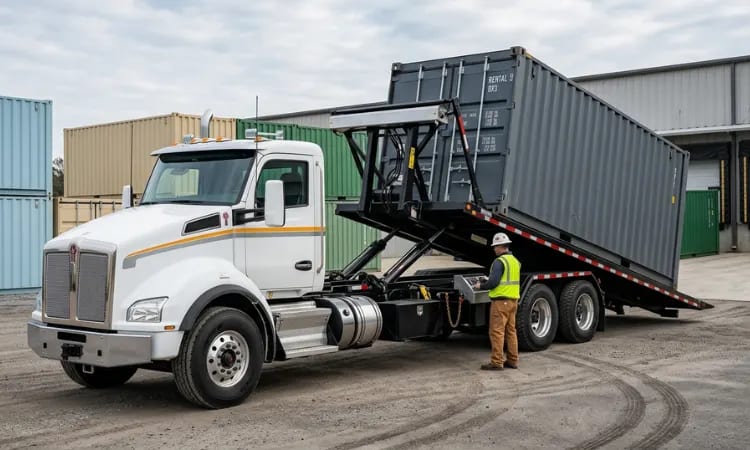
A flatbed truck and roll-off trailer used for transporting portable storage containers. AI-generated illustration.
You need a flatbed truck and a tilt-deck or roll-off trailer capable of moving a loaded 20-ft or 40-ft container. If you do not own this equipment yet, research leasing options or find a local freight company willing to handle deliveries for you in the early stages.
Define your service area before you start marketing. Deliveries that require more than an hour each way will eat margin fast. A tight local radius with consistent demand is more profitable than a wide area with scattered bookings.
Running your container rental business day to day
Keeping an accurate picture of what's rented
This sounds simple until you have fifteen containers across twelve customer sites and three of them are due for pickup in the same week. You need to know at any given moment which containers are rented, where they are, when each rental started, when it is due to end, and what condition the unit was in when it left your yard.
Operators who track this in their head or in a shared note document consistently run into the same problem: double-booking a unit, missing a pickup date, or discovering that a container has been sitting unreturned for three months without generating revenue.
Bookings, contracts, and keeping customer info straight
Every booking needs a customer record, a signed agreement, a delivery date, a rental period, and a payment schedule attached to it. This is paperwork that matters. When a customer says the container was already damaged when it arrived, you need documentation to respond to that. When a rental runs past the contracted period, you need a record showing when the original term ended.
A system for this does not have to be complicated. But it has to exist and be used consistently by everyone involved in the business.
Inspections and maintenance, before and after every rental
Photograph every container before delivery and after pickup. Document floor condition, door seal integrity, exterior rust, and any customer-added damage. This is your protection against disputes about damage that was pre-existing versus damage that happened during the rental.
Schedule a physical inspection of each container at least once per year for long-term rentals. Containers in the field are not in your yard where you can see them. Problems that develop slowly - a weeping weld, a floor board softening from moisture intrusion - are much cheaper to fix early than after a customer complains.
Getting paid on time, every time
Set up automatic billing from day one. Month-to-month rentals that require manual invoicing every thirty days create administrative overhead and introduce payment delays. Customers who are on autopay are also less likely to go delinquent.
Build a clear late payment policy into your rental agreement and enforce it consistently. A container that is not generating payment is generating storage costs and opportunity cost. Know at what point you will retrieve a unit for non-payment and communicate that clearly to customers upfront.
Mistakes that quietly kill container rental businesses
Buying more containers before the current ones are consistently booked
The math on a larger fleet looks great on paper. Ten containers at $130 per month is $15,600 per year. Twenty containers is $31,200. What the math does not show is that buying faster than your customer base grows leaves you holding containers that earn nothing while your fixed costs keep running.
Wait until your existing fleet is running above 70 percent utilization before adding units. That utilization rate tells you the market is there and your operations can handle growth. Below that, more containers just increases your exposure without increasing your income proportionally.
Letting availability tracking slip
When you lose track of which containers are available, two things happen. You miss booking opportunities because you assume units are occupied when they are not. Or you take bookings for units that are already rented and create scheduling conflicts you have to resolve under pressure.
Both problems become more frequent as the fleet grows. The operator who tracks twelve containers in a notebook is already at the edge of what manual systems can handle reliably.
Treating maintenance as a reaction instead of a routine
A container with a door that will not seal properly does not fail all at once. It develops slowly. A hinge that starts stiff, a rubber gasket that begins to crack, a weld that starts weeping after a wet winter. By the time a customer calls to complain, the problem has usually been developing for months.
Build a maintenance check into your pickup process for every returned unit. If something needs attention, address it before the container goes back out. The cost of a planned repair is almost always lower than the cost of an emergency fix after a customer complaint.
Running the whole operation off a spreadsheet
A spreadsheet works at two or three containers. It becomes unreliable at eight or ten. It fails at twenty. The failure mode is not dramatic - it is gradual. Formulas that reference the wrong cell. A pickup date entered in the wrong row. A customer record that gets overwritten when two people update the file at the same time.
By the time the spreadsheet is visibly not working, the operator has usually already missed revenue and created customer problems. The cost of switching to proper rental software at that point - rebuilding records, retraining habits - is higher than it would have been three months earlier.
Where software like RentInno fits in
The point where manual tracking actually breaks
The threshold is different for every operator, but the pattern is consistent. At some point, the combination of containers in the field, upcoming deliveries, overdue pickups, and outstanding invoices exceeds what a person can reliably hold in their head, and a spreadsheet can accurately track.
When that point arrives, operators typically experience the same cluster of problems at the same time: a double-booking, a missed pickup, an unpaid invoice that slipped through, and a customer complaint about a container that should have been serviced. These are not bad luck. They are the predictable failure mode of manual systems at scale.
What to look for in rental software built for containers
The software needs to track your fleet in real time - what is rented, what is available, what is scheduled for delivery or pickup. It needs to manage customer records and rental agreements in one place. It needs to handle invoicing and payment tracking, ideally with automated reminders. And it needs to give you a clear view of your schedule so you can plan deliveries without conflicts.
Generic business software - accounting tools, CRMs, project management apps - can be adapted for container rental, but the adaptation takes time, and the result never fits as well as something built for physical asset rental specifically.
How RentInno handles it
RentInno is built for rental businesses that manage physical inventory across multiple customer locations. For container rental operators, it tracks which units are out, where they are, and when they are due back. Bookings connect directly to customer records and rental agreements. Invoices generate automatically. Delivery schedules are visible across your team without anyone needing to update a shared document manually.
The result is that the operations running through RentInno stay manageable as the fleet grows, rather than creating more administrative overhead at each stage of growth. If you are managing your container rental operation and want to see how it would look inside the platform, check out this container rental software built for businesses like yours.
Designed to simplify rentals
From inventory to orders and quotes, RentInno keeps your equipment rental operations smooth, clear, and under control.
How to grow a container rental business
Adding container types once your base fleet is consistently booked
When your standard 20-ft and 40-ft units are running at consistent utilization, you have a base of customers who already trust you and a local reputation that is doing some of the marketing work for you. That is when adding refrigerated units, office containers, or modified storage solutions makes sense.
The right time is when customers start asking for something you do not offer. That question is a revenue signal. Answer it by adding inventory rather than sending the customer somewhere else.
Turning delivery into a paid service, not a cost you absorb
Many operators undercharge for delivery because they are afraid of losing bookings to competitors with lower delivery fees. The problem is that delivery is one of the most real and variable costs in the business. Absorbing it means your container rental fee has to cover it implicitly, which makes your headline rate look higher than competitors who separate delivery costs.
Be transparent about delivery fees. Customers who understand what they are paying for are less likely to push back on it than customers who feel a hidden cost was buried in the rate.
Locking in long-term contracts with local businesses
Construction companies, manufacturers, retailers doing seasonal inventory, and agricultural operations often need containers for months or years at a time. A twelve-month contract with a reliable commercial customer is worth more than twelve monthly residential rentals - lower administrative overhead, more predictable cash flow, and lower delivery frequency.
Pursue these relationships directly. Visit the sites, understand their storage needs, and offer a rate that reflects the value of the long-term commitment. Commercial accounts that renew annually become the backbone of a stable container rental business.
Conclusion
Container rental is a real business with real margins and a market that has been growing consistently. The operators who do well are not necessarily the ones who start biggest - they are the ones who understand their local demand before they buy, keep their delivery costs under control, maintain their containers between rentals, and switch from manual tracking to proper systems before the manual approach breaks.
Start focused. One market, two container sizes, clean agreements, and a system that keeps your inventory and your bookings organized. The fleet grows from there.
If you are ready to stop managing your container rentals on a spreadsheet, RentInno is exactly built for this. Check out how it handles fleet tracking, bookings, and invoicing for container rental businesses.
Request a product demo
Get a demo and clarify your doubts about our software.