Inside the article
Request a product demo
Get a demo and clarify your doubts about our software.
Key Takeaways
- The furniture rental market is growing at 7.1 percent annually. North America holds 35.5 percent of that market.
- Startup costs range from $15,000 for a focused niche like home staging to $150,000 or more for a full-service residential or corporate fleet.
- Well-run furniture rental businesses achieve 40-60 percent profit margins once utilization is consistent. Most pieces pay for themselves within 8-12 rental cycles.
- 2026 US tariffs on Asian imports have made new furniture meaningfully more expensive. Used and refurbished inventory is a smarter entry point for most new operators.
Introduction
The furniture rental business is not glamorous. You are moving sofas, staging bedrooms, and figuring out how to get a dining table up a flight of stairs without scratching the walls. But the numbers are real, and for operators who choose their niche carefully and manage their inventory well, the margins hold up.
What most people researching this business find confusing is the range of startup costs. $15,000 to $150,000 is not a vague estimate - it reflects how different the business looks depending on which niche you enter, how many furnitures you start with, and whether you need a warehouse from day one. This guide breaks all of that down so you can figure out what the number actually looks like for your situation.
What is a furniture rental business
How the business model works
You buy furniture, rent it out for a fixed period, collect it when the rental ends, clean and inspect it, and rent it again. The furniture piece keeps earning until it is too worn to rent, at which point you sell it and replace it.
Example: A sofa you buy for $600 can rent for $80 a month. After eight months of rental - not necessarily consecutive - you have recovered the purchase price. Every rental after that is essentially gross margin minus delivery, maintenance, and storage costs.
Who rents furniture and why
The customer base is wider than most people expect.
- Newly relocated professionals who do not want to buy before deciding where they will live long-term.
- Corporate housing companies furnishing temporary apartments for executives on assignment.
- Real estate agents staging empty homes for faster sales.
- Event companies needing lounge furniture and ceremony chairs.
- Startups furnishing office space without a multi-year lease.


Furniture rentals for home staging and special events. AI-generated illustration.
Each of these customer types wants something different in terms of rental duration, service, and price. Your niche choice sets the shape of your whole operation.
The niche you choose determines your customer relationships, your delivery frequency, and how much your pieces wear out. Getting this wrong at the start is expensive to fix.
Is a furniture rental business worth starting
Market size and demand trends
The global furniture rental market is forecasted to reach $115.62 billion by 2035, growing at 7.1 percent annually according to Research Nester. North America holds 35.5 percent of that market, driven by high urban mobility, corporate relocation activity, and the growth of short-term housing.
The event and party segment grows faster than the broader market - above 14 percent annually - because demand is tied to weddings, corporate events, and social gatherings that do not pause during economic uncertainty the way big-ticket furniture purchases do.
How much a furniture rental business can earn
Revenue depends almost entirely on "utilization" - what percentage of your inventory is out on rental at any given time.
An operator with 100 pieces of furniture averaging $70 per month in rental fees, running at 70 percent utilization, generates roughly $4,900 per month before costs. Scale that to 300 pieces and you are looking at around $14,700 monthly gross.
Well-run businesses reach 40-60 percent profit margins once inventory costs are paid off and the logistics side is running efficiently. The first 12-18 months are tighter while you build utilization and recover the initial inventory investment. Most furniture pieces break even within 8-12 rental cycles, which sets the pace for how quickly the business becomes genuinely profitable.
Why the startup cost varies so much
The range - $15,000 to $150,000+ - exists because the business looks very different at either end.
A home staging operator can start with 30-50 carefully chosen pieces, store them in a rented garage or small self-storage unit, and handle deliveries with a rented truck. Total startup investment can stay under $20,000.
A full-service residential furniture rental company furnishing apartments needs more inventory, a proper warehouse, professional delivery equipment, and a customer-facing booking process. Getting that operation to the point where it can reliably serve clients often requires $80,000 to $150,000 upfront.
Neither approach is right or wrong - they just serve different markets and carry different risk profiles.
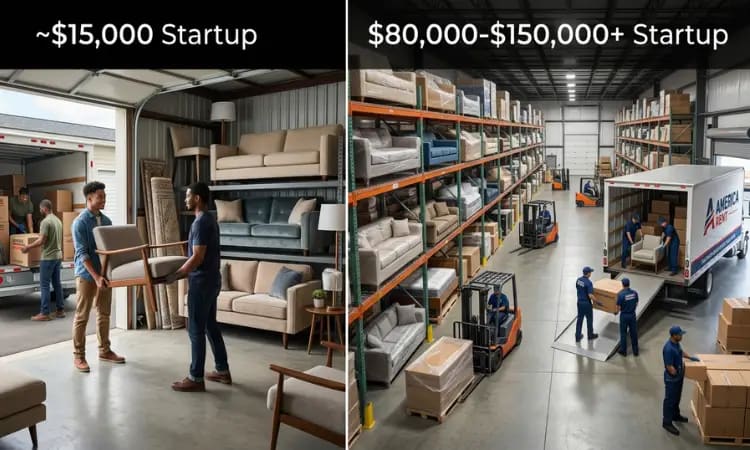
A comparison of lean and full-scale furniture rental business models based on startup investment. AI-generated illustration.
Types of furniture rental niches to choose from
Residential and home staging
Home staging means furnishing empty properties to make them more attractive to buyers. Real estate agents hire staging companies to transform a blank space into something people can imagine living in. Rentals typically run 1-3 months, and agents tend to be repeat customers in active housing markets.
Upside:
- Demand is consistent and professional.
- Real estate agents are repeat buyers, not one-off customers.
Downside:
- The business is exposed to housing market changes. When listings drop, staging revenue follows.
- Presentation matters constantly. Pieces that show wear get retired faster than in other niches, so your refresh budget needs to account for that.
Corporate and office furniture
Companies furnishing temporary offices, setting up remote work spaces for employees, or needing furniture for a project site are consistent corporate renters. Relocation companies that arrange temporary housing for executives are among the highest-value clients in this category. They are professional buyers with long-term relationships.
Rental periods in this niche tend to be longer. Three to twelve months is common, and contract sizes are larger. A single corporate client might furnish ten apartments at once, which is great for utilization but means you need enough inventory to service the contract reliably.
Upside:
- Longer rental periods and larger contract sizes.
- Corporate clients can create recurring business and long-term relationships.
Downside:
- Sales cycles are longer.
- Clients often expect volume discounts.
- You need enough inventory capacity to fulfill larger contracts.
Event and wedding furniture
Event furniture rental is one of the fastest-moving segments in the furniture rental industry. Wedding planners, corporate event organizers, venues, and private hosts rent items like lounge seating, chairs, tables, and décor pieces for short-term events. A set of chairs or a lounge collection rented for a weekend event can return to your inventory quickly and be booked again for another customer.
Upside:
- High utilization potential.
- Inventory can generate revenue multiple times throughout the year instead of staying with one customer for months.
Downside:
- Demand is highly seasonal.
- Weekends during wedding and event seasons can be extremely busy, while slower months may leave inventory sitting unused.
Buying new vs used furniture for your fleet
When buying new makes sense
New furniture makes sense when the visual appearance of the piece is part of what the customer is paying for. Home staging clients, upscale event operators, and corporate housing companies expect clean, contemporary pieces with no signs of previous use. If your business depends on that presentation, buying new gives you more control over the condition and style of your inventory.
Buying new also makes early maintenance planning more straightforward. You know the history of the piece, you know when it was purchased, and you can make more accurate assumptions about when it will need attention or retirement.
When used or refurbished is the smarter start
For most new operators, starting with good-quality used furniture bought below market value is the financially smarter move. You recover your investment faster because the purchase cost is lower, which means each piece reaches its break-even point in fewer rental cycles.
What most new operators underestimate is how much faster rental inventory degrades than home-use furniture. A sofa used in 10 rentals over 18 months has had more total use than most consumer sofas see in five years. Starting with used inventory means you are also buying yourself the experience to know what holds up under that level of use and what does not.
How 2026 USA tariffs are changing this decision
The 2026 tariff environment has pushed the cost of new furniture higher across the board. Most consumer and commercial furniture sold in the US is manufactured in China and Vietnam - two of the countries most affected by current US import tariffs. Duties on Chinese furniture imports range from 25 to over 100 percent depending on the product category, which flows directly into retail and wholesale pricing.
In practice, this means a sofa that cost $800 wholesale in 2023 may cost $1,100 or more in 2026. For a furniture rental business building an inventory of 100+ pieces, that gap is substantial. The used and domestic furniture markets look much more attractive as a result. Domestic manufacturers - particularly those producing commercial-grade pieces - are busier than usual, which means lead times are longer. Factor that in if you need inventory fast.
What it costs to start a furniture rental business
Inventory costs by furniture type
Here is a realistic cost range for common furniture rental inventory in 2026, buying new at commercial wholesale prices. Used inventory typically runs 40-60 percent less.
Item
New Wholesale Cost
Monthly Rental Rate
Break-Even Cycles
Sofa (mid-range)
Dining table + 4 chairs
King bed frame + mattress
Chiavari chair (per unit)
Office desk + chair
Lounge sofa set (event)
Warehouse, delivery, and software costs
Warehouse space is often the first unexpected major cost. If you are renting storage units, expect $200-$600 per month depending on your market and how much space you need. A proper commercial warehouse with loading dock access for easy truck movement starts at $800-$2,000 per month in most mid-size cities, significantly more in expensive markets.
Delivery equipment - a cargo van or box truck capable of moving furniture - runs $30,000-$60,000 to buy used, or $800-$1,500 per month to lease. If you outsource delivery to a third-party service initially, budget $100-$300 per delivery depending on the size of the order and distance.
General liability insurance runs roughly $57 per month ($686 per year) at the median for small furniture rental operations, though this rises with revenue and fleet size. Rental management software like RentInno, starts free with inventory tracking, booking, invoice & quotations and some scales to $30-$100 per month for platforms that handle enterprise level orders.
Bootstrap vs full-scale budget
Budget Level
Inventory
Storage
Delivery
Total Estimate
Bootstrap ($15K-$30K)
Mid-range ($40K-$80K)
Full-scale ($100K-$150K+)
How to launch your furniture rental business
Research your local market and pick your niche
The biggest mistake new operators make is trying to serve everyone at once. Pick one niche, understand who the customers are, and get good at serving them before expanding. Call five real estate agents in your area and ask what staging companies they use and what they pay. Visit corporate relocation companies and ask how they currently handle furniture for temporary housing. Attend a local wedding fair and see who is renting event furniture and at what price points.
That conversation-based research tells you two things: whether the demand exists and whether there is room for a new operator at your price point. Neither question gets answered by a Google search.
Write a business plan
Your business plan does not need to be a long document. It needs to be specific enough to answer three questions,
Q1. How many pieces do you need to break even?
Q2. What will you charge for them?
Q3. How long before the business is cash-flow positive?
Work the numbers backward. If your monthly operating costs are $3,000 (storage, insurance, software, miscellaneous), and you charge an average of $90 per piece per month, you need 34 pieces rented consistently to break even. That tells you your minimum viable fleet size and helps you evaluate whether your startup budget makes sense.
Register your business, get licensed, and get insured
Set up your business structure before taking your first rental booking. Many furniture rental operators choose an LLC because it separates personal and business liability. Registration costs vary by state, but typically range from $50-$500. You can apply for an EIN through the IRS website for free, and you will need it for opening a business bank account, hiring employees, and handling tax reporting.
Insurance is a critical part of running a furniture rental business because your inventory is constantly moving between locations. A basic policy should usually include:
- General liability insurance: Covers claims if someone is injured because of your furniture or during delivery and setup.
- Commercial auto insurance: Required if you use a vehicle for deliveries. Personal auto policies usually exclude business use.
- Commercial property or inland marine coverage: Helps protect your furniture inventory while it is stored, transported, or at a customer location.
A small furniture rental operation can often get basic coverage for around $1,000-$2,000 per year, but costs depend on your inventory value, location, vehicles, and coverage limits.
Build your brand and website
Your website has one main job: help potential customers understand your furniture, trust your business, and request a rental.
High-quality photos of your actual inventory matter more than having a complicated website. Customers want to see the condition, style, and setup of the furniture they are renting.
Your content should match your niche:
- Home staging: Show before-and-after transformations and professionally staged rooms.
- Event rentals: Show complete event setups with furniture arranged in real venues.
- Corporate and residential rentals: Show fully furnished apartments, offices, and living spaces.
The goal is not just to display individual furniture pieces. It is to help customers visualize how the finished space will look.
How to price your furniture rentals
Monthly rates and duration discounts
Monthly rental rates for residential furniture typically run 5-10 percent of the retail purchase price per month. A sofa with a retail value of $1,200 might rent for $60-$120 per month. The 5 percent rate is standard for longer rentals (6+ months) where the customer is paying for convenience and flexibility. The 10 percent rate is more appropriate for shorter terms where your piece could otherwise be earning through faster turnover.
Duration discounts reward longer commitments and reduce your administrative overhead. A customer who commits to six months requires one delivery, one pickup, and one contract. A customer who rents month-to-month for six months requires the same number of rental periods but may not renew. Pricing that rewards commitment reduces your uncertainty.
Package pricing and add-ons
Package pricing bundles multiple pieces together at a rate lower than the sum of individual prices. A furnished bedroom package - bed, nightstands, dresser, lamp - is more appealing to a relocating professional than pricing out five individual pieces. It also increases your average order value and makes your inventory work together rather than in isolation.
Add-ons that increase revenue per booking include delivery and setup (charge this separately rather than burying it in the rental rate), damage waiver programs, and optional extras like linens or decor for staging or event clients. Do not bundle these invisibly. They are services customers genuinely want and will pay for when priced clearly.
Pricing against local competition
Find three to five local competitors and request quotes as a prospective customer. You are looking for their pricing structure (daily, weekly, monthly), what is included in the delivery fee, and what their minimum order or rental period is. Do not simply undercut them. Understand what you offer that they do not and price accordingly.
If you are newer with less inventory, you may need to start slightly below market to win your first clients and build reviews. Once you have ten or more positive customer references, your pricing can move toward or above the market rate if your quality and service justify it.
How to get your first customers
Partnering with stagers, realtors, and corporate housing
Your best early customers already exist. Real estate agents who stage homes regularly either have a staging company they work with or are looking for one. Corporate relocation managers need reliable furniture for temporary housing and will work with the same vendor repeatedly if the experience is good. Visit in person, bring your portfolio, and offer a first-rental discount to get them to try you.
A single real estate agency that recommends you to three agents, each with two listings per month, can keep eight to twelve pieces rented consistently. A corporate housing company that uses you for even five apartments per month is a significant anchor account. These relationships are worth more than any advertising spend in your first year.
Getting found through local SEO
When someone in your city searches 'furniture rental for home staging' or 'corporate furniture rental [city name],' your website should appear. Set up a Google Business Profile before you take your first booking. Fill it with photos, your service area, and a clear description of what you offer. Collect reviews from every customer.
Create service pages on your website for each niche you serve - a page specifically for home staging, a page for corporate housing, a page for events if applicable. These pages, with your city name used naturally throughout, give search engines the context to show your business to people looking for what you do.
Social media and referrals
Instagram and Pinterest are where staging and event rental content performs best. Show finished setups, not individual pieces. A photo of a staged living room converts better than a photo of a sofa on a white background. Tag the agents, venues, and event planners you work with. When they reshare your content to their audiences, you reach people who already trust them.
Build a referral incentive from day one. A 10 percent credit on the next rental for any customer who sends you a new booking is simple and effective. The most reliable source of new customers for a local furniture rental business is other customers who have used you and were happy with the experience.
Running your furniture rental business day to day
Delivery, pickup, and scheduling
Delivery and pickup is where operations either run well or create a steady stream of problems. A badly routed delivery day adds hours to your schedule, burns more fuel, and leaves your driver running out of time by the last stop. Route planning software that batches deliveries by geography is worth the setup time.
Photograph every piece before delivery and after pickup. This documentation is your protection when a customer claims damage was pre-existing or disputes a damage charge. Without photos, those disputes are unresolvable in the customer's favor. With photos, they are straightforward.
Inspections and maintenance
Every piece that comes back from a rental needs a consistent inspection before it goes back into available inventory. Check the upholstery for stains, the frame for structural damage, and all hardware for function. A piece that goes out with a loose leg or a stain that was not caught in time is a problem you are sending directly to your next customer.
Build a maintenance schedule for pieces that are renting regularly. Upholstery cleaning, wood touch-ups, hardware tightening - these are cheap when done routinely and expensive when deferred until something fails during a rental. Deferred maintenance also shortens the life of a piece, cutting into the rental cycles you have left to earn back the purchase cost.
Where software like RentInno fits in
At two or three pieces, you can track everything in a notes app. At fifteen pieces across eight customers with overlapping rental periods and different pickup dates, that same approach starts generating mistakes - double-booked pieces, missed pickups, invoices that go out late.
RentInno is built for this exact transition. It tracks which pieces are rented, where they are, and when they are due back. Quotes connect to orders, invoices generate automatically, and your inventory availability updates in real time as bookings are added.
The practical question is not whether you need software but when. The answer for most operators is: before you think you need it. The cost of switching systems after you have grown into a manual tracking problem - rebuilding records, retraining habits, sorting out errors that accumulated during the transition - is higher than setting up a proper system early.
Designed to simplify rentals
From inventory to orders and quotes, RentInno keeps your equipment rental operations smooth, clear, and under control.
Mistakes to avoid
Buying inventory before confirming demand It is tempting to build a large inventory before your first customer, but unused furniture ties up your capital. Get your first two or three confirmed clients before buying more than you need.
Pricing delivery too low Furniture delivery is time-consuming and often involves stairs, elevators, and tight spaces. A flat delivery fee that does not cover the real cost can quickly reduce your margins. Price delivery separately and accurately from the beginning.
Treating all customers the same A residential customer renting a furnished apartment has different needs than a corporate housing company furnishing multiple units. Your communication, contracts, and service process should match each customer type.
Skipping insurance until something goes wrong Furniture damage, delivery accidents, and customer disputes are common risks in this business. Proper insurance protects you from unexpected costs when these situations happen.
Waiting too long to track inventory properly Losing track of furniture location, availability, or return dates is one of the most common operational problems. Start with an inventory system that can grow as your rental business expands.
Conclusion
The operators who build something profitable are the ones who pick a niche they actually understand, buy inventory that survives repeated use, price their services to cover the real cost of delivery and maintenance, and track their fleet from day one. The business is not complicated. The discipline is.
The market is real, the margins are real, and demand across residential, corporate, and event segments has been growing for years. Whether you capture any of it depends almost entirely on how well you run the operations side.
If you are getting ready to launch or scale your furniture rental business, take a look at how RentInno handles inventory tracking, bookings, and invoicing for rental operations like yours.
Request a product demo
Get a demo and clarify your doubts about our software.