Inside the article
Request a product demo
Get a demo and clarify your doubts about our software.
Key Takeaways
- Equipment depreciation helps businesses spread equipment costs over their useful life.
- Different depreciation methods suit different financial and tax goals.
- Depreciation helps rental businesses track true profitability and plan replacements.
- Usage-based depreciation is often the most accurate method for rental equipment.
- Consistent depreciation tracking improves financial planning and tax management.
What Is Equipment Depreciation?
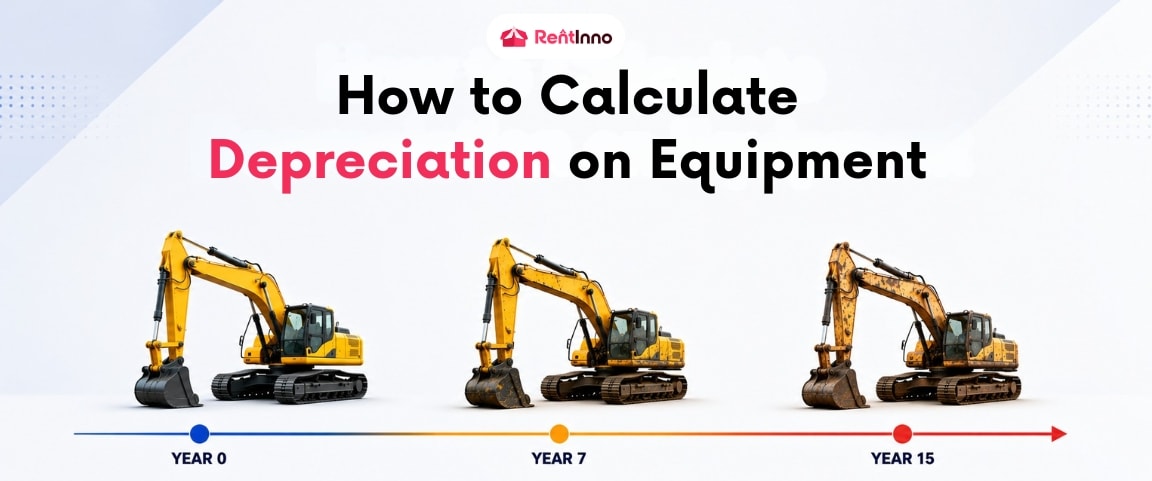
Think about things like a generator, a forklift, or a mini excavator. These machines lose value over time because they get used, become older, and wear out.
Do you know why this happens?
Let's take an iPhone as an example. Imagine you buy an iPhone 16 today, and when a newer model launches, the hype around the older model starts to fade. People prefer the latest version, so the value and even the rental price of the older iPhone decreases.
The same thing happens with equipment as newer models enter the market and older machines go through regular usage; their value gradually drops over time.
This loss in value is called depreciation.
If you have a business, it is really important to know how to figure out depreciation. Knowing how to calculate equipment depreciation is a useful skill for you to have with money.
To calculate depreciation, you need four things:
- The total cost of the equipment
- The estimated salvage value at the end of its life
- The useful life in years
- The method you want to use
This guide will walk you through each depreciation method. It will provide formulas and real examples. Then it will explain how to pick the method for your situation with the equipment.
Why Depreciation Matters for Your Rental Business
Depreciation is not something you have to do for accounting. For people who run businesses, depreciation is really important because it shows how much money your rental properties are actually making, and it helps you plan for what is going to happen in the future with your rental businesses.
It shows your true profit margin
When you have a machine that earns eight thousand dollars in rental money every year, but it loses six thousand dollars in value over the same time, the money you really get to keep is not as much as you think. If you do not keep track of how much value the machine loses, you might charge too much or too little for people to use your rentals, and you will not even know you are doing it.
It helps you plan replacements
As depreciation accumulates, it tells you where each asset sits in its financial life, which gives you time to budget for replacements before breakdowns become a problem.
It reduces your tax bill
The IRS allows businesses to deduct depreciation as an ordinary business expense. Choosing the right method, or combining it with provisions like Section 179 and bonus depreciation, can reduce your taxable income in the early years of ownership.
It informs your rental pricing
Many rental operators build depreciation into their floor rates so that every rental day contributes to recovering the original purchase cost. A widely used benchmark is to budget around 20 percent of the purchase price annually when setting rates.
Depreciation Methods Explained Simply
There is no single method that works for every situation. Some spread the cost evenly over time, others front-load deductions into the early years. The right choice depends on the type of equipment and what you are trying to achieve.
Straight-line method
The straight-line method is the simplest and most commonly used approach. You deduct the same amount every year across the asset's useful life with no recalculation required.
Formula: Annual Depreciation = (Cost - Salvage Value) ÷ Useful Life
Example: A compressor purchased for $20,000 with a $2,000 salvage value and a 9-year useful life: ($20,000 − $2,000) ÷ 9 = $2,000 per year.
This method works best for equipment that delivers consistent value year over year and for businesses that want stable, predictable annual expenses.
Declining balance method
Instead of applying a rate to the original cost, the declining balance method applies a fixed rate to the remaining book value each year, producing larger deductions early in the asset's life and smaller ones later. The standard rate is 150 percent of the straight-line rate, as outlined in the MACRS guidelines established under US tax law.
Formula: Annual Depreciation = Book Value at Start of Year × (1 ÷ Useful Life × 1.5)
Example: Same $20,000 compressor, 9-year life. Declining balance rate = 16.67 percent.
Year
Book value (start)
Depreciation
Book value (end)
1
2
3
This method suits equipment that loses value faster in its early years, such as vehicles, technology, and most power equipment.
Double declining balance method
The double declining balance method follows the same logic as the declining balance method but uses 200 percent of the straight-line rate instead of 150 percent, making it one of the most aggressive standard depreciation approaches available. Once the calculation would reduce the book value below the salvage value, you switch to straight-line for the remaining years.
Formula: Annual Depreciation = Book Value at Start of Year × (2 ÷ Useful Life)
Example: $20,000 compressor, 9-year life. DDB rate = 22.22 percent.
Year
Book value (start)
Depreciation
Book value (end)
1
2
3
This method works best for high-tech equipment or any scenario where maximizing early-year tax deductions is the goal.
Sum-of-the-years'-digits method
The sum-of-the-years'-digits method is an accelerated approach that applies a declining fraction to the original depreciable base each year. It produces larger deductions early on without requiring you to recalculate a rate against a changing book value, making it slightly simpler to manage than the double declining balance method.
Formula: Annual Depreciation = (Remaining Useful Life ÷ Sum of Years' Digits) × (Cost − Salvage Value)
For a 9-year asset, the sum of digits is 9+8+7+6+5+4+3+2+1 = 45.
Example: $20,000 compressor, $2,000 salvage value, 9-year life. Depreciable base = $18,000.
Year
Fraction
Annual depreciation
1
2
3
9
This is a good middle-ground option when you want accelerated deductions but prefer a simpler calculation structure.
Units of production method
The units of production method ties depreciation to actual usage rather than time, so the expense rises and falls with how hard the machine is worked in a given year rather than simply how old it is.
Formula: Depreciation per Unit = (Cost − Salvage Value) ÷ Total Estimated Units of Production. Annual Depreciation = Rate × Units Used That Year.
Example: A $50,000 machine with a $5,000 salvage value expected to run 450,000 hours total. In Year 1, it logs 60,000 hours: ($50,000 − $5,000) ÷ 450,000 = $0.10/hour × 60,000 = $6,000.
For rental businesses, this is often the most accurate choice because depreciation moves with revenue. High-utilization years carry higher depreciation, and slower periods carry less, giving you a clearer picture of what each asset actually earns versus what it costs.
How to Calculate Equipment Depreciation
Regardless of which method you choose, every depreciation calculation starts with the same four inputs. Here is how to determine each one.
Step 1 - Know your cost basis
Your cost basis is not just the purchase price. According to IRS Publication 946, it includes sales tax, freight charges, and installation and testing fees paid to get the equipment ready for use. If you buy a generator for $30,000 and spend $2,000 on freight and installation, your cost basis is $32,000. Every year of your depreciation schedule builds from that number, so getting it right from the start is important.
Step 2 - Estimate salvage value
Salvage value is what you expect the equipment to be worth at the end of its useful life, whether through resale, trade-in, or scrap. If you do not have specific market data, using 10 to 15 percent of the original purchase price is a reasonable starting point. For tax calculations under MACRS, the IRS always assumes zero salvage value, which is one reason your tax and book depreciation schedules often look different, as detailed in IRS Publication 946.
Step 3 - Determine useful life
Useful life is the number of years you expect the equipment to remain productive. The IRS provides standard recovery periods through asset class tables in IRS Publication 946, and the most common ones for equipment-heavy businesses are listed below.
Equipment type
IRS recovery period
Automobiles and light trucks
Heavy construction equipment
Industrial machinery
Agricultural machinery
Non-residential buildings
For financial reporting, you can use a different estimate based on your operating experience. Equipment used intensively or in harsh conditions may wear out faster than the IRS default suggests.
Step 4 - Choose a depreciation method
With cost basis, salvage value, and useful life confirmed, you are ready to choose a method. Apply the formula, record the result in a depreciation schedule for that asset, and update it at the end of every year. Consistency across similar asset classes is important for clean financial reporting and straightforward audits.
Choosing the Right Method
The right method depends on what you are calculating for. Most businesses run two separate depreciation schedules, one for taxes and one for financial reporting.
tax purposes (MACRS)
The IRS requires most businesses to use the Modified Accelerated Cost Recovery System, or MACRS, which applies the 200 or 150 percent declining balance method depending on asset class and always assumes zero salvage value, as covered in IRS Publication 946.
Two additional provisions can accelerate deductions further. Section 179 allows businesses to immediately expense qualifying equipment purchases in the year of purchase, with a 2025 deduction limit of $2,500,000 before the phase-out begins at $4,000,000 in total qualifying purchases.
Bonus depreciation was also reinstated at 100 percent for property placed in service after January 19, 2025, after phasing down to 60 percent in 2024, as detailed in the IRS Form 4562 instructions. Because these rules change frequently, confirming current limits with a CPA before large purchases is always a good idea.
For financial/book reporting
Under GAAP, the goal is to match the depreciation method to how the equipment delivers value over time. Equipment that contributes roughly equal value each year fits straight-line.
Equipment that is most productive in its early years is better served by declining balance or sum-of-the-years'-digits. Whatever method you choose, apply it consistently across similar asset classes and avoid switching without a clear reason, since inconsistency makes year-over-year comparisons unreliable.
For variable-use equipment
For rental businesses, the units-of-production method is usually the most accurate choice because it directly links depreciation expense to how much the asset was actually used. A busy year produces higher depreciation alongside higher revenue, and a slow quarter brings both down together.
This gives you a much clearer view of what each machine actually earns versus what it costs, and it works especially well for excavators, aerial lifts, generators, and any equipment where wear correlates directly with hours run or cycles completed.
Metrics like utilization rate and revenue per asset covered in detail in our guide to rental inventory management KPIs work hand in hand with usage-based depreciation to show you exactly where each piece of equipment stands financially.
Conclusion
Calculating depreciation on equipment comes down to four inputs done consistently: an accurate cost basis, a realistic salvage estimate, a useful life grounded in IRS guidance, and a method matched to your goal. For most rental businesses, maintaining a per-asset depreciation schedule updated every year is the most practical way to keep your financials honest and your tax planning on track.
If you want to manage equipment costs, utilization, and rental operations together in one place, RentInno is built for that. Start your 14-day trial at no cost.
Request a product demo
Get a demo and clarify your doubts about our software.