Inside the article
Request a product demo
Get a demo and clarify your doubts about our software.
Key Takeaways
- The global photo booth rental market was valued at $1.2 billion in 2025 and is growing at 8.8 percent annually through 2033.
- A single booth renting at $800 to $1,200 per event at four events per month generates $38,400 to $57,600 annually.
- Startup costs range from $3,500 to $25,000, depending on booth type. Most operators break even within 6 to 12 months.
- Net profit margins typically run 50 to 70 percent once you account for operating costs per event.
- Weddings, corporate events, and birthday parties are your three most consistent customer segments.
Introduction
Not many businesses let you charge $1,000 for three hours of work while guests do most of the entertaining. Photo booth rental is one of them. The model is simple, startup costs are manageable, and even a part-time operator with one booth can build real income.
But simple does not mean automatic. This guide covers everything you need to know before you spend a dollar.
What is a photo booth rental business?
A photo booth rental business is exactly what it sounds like. You own the equipment, you show up at events, and people pay you for a few hours of entertainment that practically runs itself.
The business model is built around low variable costs, high margins, and demand that spans every type of event in the calendar.
How the business model works
You own photo booth equipment and rent it out for events. The customer pays a flat fee for a set number of hours. You deliver, set up, and break down at the end. The variable cost per event is low - primarily printing supplies and fuel - which is why margins stay high even as you grow.
Most operators start with one booth and grow by adding units as demand builds.
Who hires photo booths and why
Weddings drive the most consistent demand. About 67 percent of couples include a photo booth in their reception, according to The Knot Real Weddings Study. Corporate events are the fastest-growing segment. Birthdays, proms, galas, and holiday parties fill the rest of the calendar.
Every customer wants the same thing: something memorable for guests and shareable content for social media. A photo booth delivers both.
Is a photo booth rental business worth starting?
Market size and demand trends
The global photo booth rental market was valued at $1.2 billion in 2025 and is forecast to reach $2.5 billion by 2033 at an 8.8 percent annual growth rate. North America holds 40 percent of global revenue. Over 45 percent of weddings and corporate events in the US now include photo booth services, a figure that has grown consistently for five consecutive years.
The trend toward interactive entertainment sustains demand. The addition of 360-degree video, AI filters, and instant social sharing has expanded the market well beyond weddings.
How much a photo booth rental business can earn
Four events per month at $1,000 average generate $48,000 annually. A full-time operator doing 12 or more events can reach $144,000 or higher. After $3,000 to $5,000 in annual operating costs, net profit runs $5,000 to $7,000 per month for a single-booth operation.
Why the startup cost is lower than most rental businesses
A photo booth fits in a standard car and sets up in 20 to 30 minutes. No storage yard, no specialist vehicle, no CDL. Your highest upfront cost is the booth itself - a professional open-air setup runs $3,500 to $8,000 new.
Low capital and high margins make this more attractive than most event services. A DJ invests similarly but spends far more labor per event at the same price point.
Types of photo booths to offer
Open-air photo booths
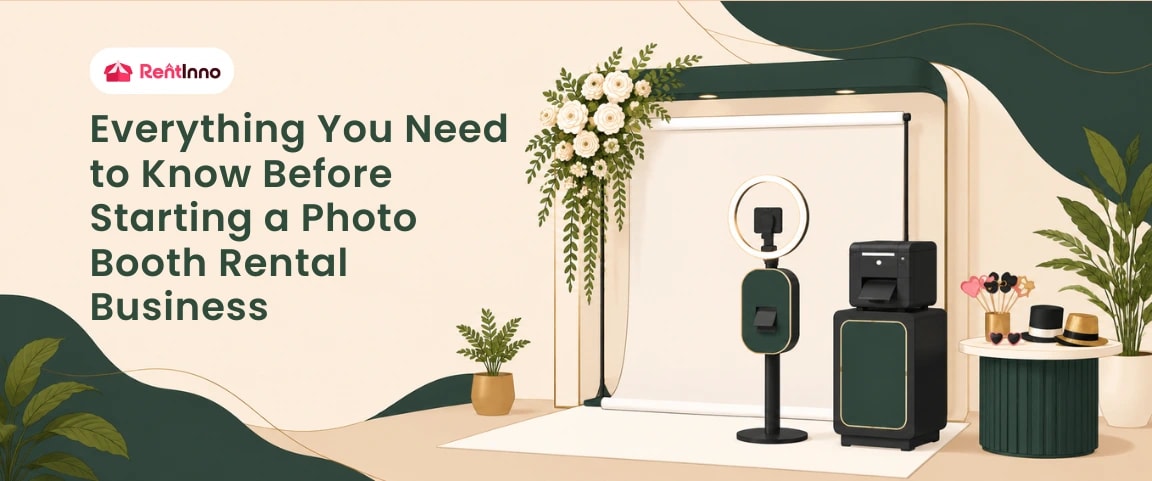
Open-air booths are the market standard and the right starting point. A camera on a stand, a backdrop, and a printer. Setup is fast, transport is easy, and customers use them without instruction. They account for 59 percent of market demand and are where most new operators start.
360 and mirror photo booths
360-degree booths rotate a camera arm around guests to create slow-motion video. Mirror booths are interactive displays with animations and prompts. Both require more setup time and a larger vehicle but attract higher-budget corporate and wedding clients.
GIF, slow-motion, and green screen booths
These are software features, not separate hardware categories. Most open-air setups can produce GIFs, slow-motion, and green screen composites with the right software. Offer them as add-ons without buying new equipment.
Roaming photo booths
A roaming booth is a handheld camera rig that an attendant carries through an event. Photos can be printed on a portable printer or sent digitally. Lower cost to buy and operate, good for cocktail hours and venues where a stationary setup does not work.
What it costs to start a photo booth rental business
Equipment and software costs by booth type
Booth Type
Equipment Cost
Software Cost/Year
Rental Rate/Event
Open-air booth
Mirror booth
360-degree booth
Roaming booth
Insurance, permits, and legal setup
General liability insurance runs $500 to $1,500 per year. Some venues require a certificate of insurance before allowing you on their property, so get coverage in place before you start marketing to venues.
Marketing and branding costs
Budget $300 to $1,500 for a website, Google Business Profile, and sample photos. Brand visuals matter more here than in most businesses - customers judge quality entirely by what they see online before booking.
How long before you break even
Most operators break even in 6 to 12 months. At four events per month, averaging $900, a $6,000 booth is recovered in under two months of net profit. 360-degree booths at $15,000 to $20,000 take longer but generate more per booking.
Buying vs renting your photo booth equipment
When buying makes financial sense
If you have two or more confirmed bookings before launch, buying makes sense. Owning your equipment gives you full pricing flexibility, no rental fees eating into margins, and the ability to brand the booth yourself. Most operators who plan to run this as a real business buy from the start.
When renting or leasing is the better start
Renting before buying makes sense if you are testing a market or waiting for purchased equipment to arrive. Leasing spreads the capital cost over monthly payments while booking volume builds.
How to launch your photo booth rental business
Market research and niche selection
Check local competitor websites and Facebook wedding groups before you launch. What are operators charging? What booth types exist in your market? A gap in 360-degree booths is an opportunity. Five open-air operators at $500 per event require a differentiated offer to enter profitably.
Writing a business plan
Your plan needs three numbers: what you charge, how many events per month cover fixed costs, and your break-even timeline. Add a marketing plan and a six-month booking target. Keep it simple. If you want a broader framework covering business structure, legal setup, and operational planning, our guide on starting a rental business covers the full picture.
Legal registration and insurance
Register your LLC, get your EIN through the IRS website, and secure your general liability coverage. Then prepare a signed rental agreement for every booking. Cover the rental period, damage deposit, and cancellation terms. Have a local attorney review it - a generic template may not hold up in your state.
Building your brand and website
Your website needs four things: a photo gallery, pricing or a starting-from rate, a booking form, and testimonials. Most customers decide based on the gallery alone. Invest in good event photography early, even at a discounted rate. Those first-month images will market your business for the next two years.
How to price your photo booth rentals
Per-event pricing and package structures
Starting framework: $600 to $800 for three hours digital-only, $900 to $1,200 for four hours with unlimited prints, $1,400 to $2,000 for premium packages with custom overlays and an attendant. Charge $150 to $200 per extra hour for events that run long.
Add-ons that increase revenue per booking
Props ($50 to $100), custom overlays ($75 to $150), gallery hosting ($50 to $75), extra hours ($150 to $200), and GIF upgrades ($100 to $200) convert well and add minimal cost. A $700 base booking with $300 in add-ons becomes a $1,000 job.
How to price against local competition
Check three to five local competitors. Enter 10 to 15 percent below the market while you build reviews. Once you have ten or more five-star reviews, price to match or exceed. 360-degree booths can be priced above the local market if no competitor offers them.
How to get your first bookings
Partnering with event planners and venues
A single wedding venue recommending you to 30 couples per year is worth more than any ad spend. Visit venues in person, leave a sample print strip, and offer a 10 to 15 percent referral fee. Build those relationships before anything else.
For a full breakdown of digital and local marketing channels beyond venue partnerships, our equipment rental marketing guide covers what works and what wastes your budget.
Getting found through local SEO and Google Maps
Set up your GBP before you launch and collect reviews after every event. A listing with ten or more reviews consistently outranks older competitors who neglected theirs. Include your city and surrounding areas in your website copy.
Using social media to show your work
Instagram and TikTok are where photo booth content performs best. Post event clips, setup videos, and sample prints. Tag venues - they often reshare supplier content, putting you in front of their whole audience for free.
Building repeat business through referrals
Send a follow-up to every customer two days after the event. Thank them, ask for a review, and offer a referral discount. Guests who used your booth at someone else's event are already warm leads.
Conclusion
One booth, one market, a clear price structure, and consistent effort on reviews and venue relationships. That combination generates sustainable income faster than any amount of equipment without the customer foundation to support it.
The market is growing, the margins are real, and the entry barriers are lower than almost any other event service. The operators who last treat the business side as seriously as the equipment side.
If you want software to manage your photo booth bookings, client records, invoices, and equipment availability in one place, RentInno is built for event rental businesses like yours.
Request a product demo
Get a demo and clarify your doubts about our software.