Inside the article
Request a product demo
Get a demo and clarify your doubts about our software.
Key Takeaways
- A well-run jet ski rental business in a high-demand location generates $5,000 to $10,000 per month during peak season, with established beachfront operations crossing $1 million annually.
- A three-ski starter operation in the US requires between $40,000 and $85,000 in startup capital.
- Commercial insurance for a small jet ski rental fleet runs $5,000 to $15,000 per year and is non-negotiable.
- State licensing requirements vary significantly. Florida, California, and New York each have different boating safety certification rules that affect your operation.
- Booking software, digital waivers, and online reservations are not optional upgrades. They are what separates a profitable operation from a chaotic one.
- The top revenue lever most owners ignore is guided tours, which bring in $150 to $300 per person and extend your season by attracting customers who would not do a solo rental.
Some businesses are exciting to read about but underwhelming in reality. A jet ski rental business is not one of them.
The math is unusually straightforward. You own an asset that people will pay $75 to $150 per hour to use, repeatedly, throughout an entire season. In a beachfront market with consistent foot traffic, a single jet ski earning $120 per hour for six hours a day over three peak months generates over $65,000 in gross revenue before expenses.
That is one unit.
One of the most-cited real-world examples in this space from Bizbuysell is a Clearwater JetSki Rentals, Florida operation that has been running since 1981. It combines jet ski rentals with tour boats, generates $1,465,000 in annual revenue, and produces $815,000 in cash flow on just two employees and a 56% margin.
That is what this business looks like at full maturity. Getting there takes time, smart decisions, and a clear plan. This guide gives you that plan, with real numbers, real legal requirements, and the operational detail most guides skip entirely.
Is a jet ski rental business profitable?
The short answer is yes, under the right conditions. But let us get specific about what that means.
Revenue potential in tourist and waterfront markets
A jet ski rental business's revenue can range from $5,000 to $10,000 monthly, depending on location, fleet size, and rental rates. High-demand areas can see higher earnings, especially during peak season.
Interior lake markets behave differently. A business near Folsom Lake in Northern California, operating eight well-maintained jet skis with over 1,000 customers and 127 five-star reviews, is listed as a turnkey operation with strong seasonal cash flow, despite being nowhere near a coastline.
The lesson here is that high tourism density matters more than geography. Lakes, reservoirs, and rivers near major cities can match coastal revenue if the foot traffic is there.
Seasonality and local demand considerations
Some businesses make over 60% of their annual revenue in just a few peak months. In northern US states, that window can be as narrow as June through August. In Florida or Southern California, your season stretches significantly longer.
This seasonality is the central financial planning challenge. A jetski rental business making $40,000 in July needs to cover insurance, storage, loan payments, and marketing in February when the skis are sitting in a warehouse. Operators who survive long term either diversify into year-round offerings like tours and lessons, or they budget aggressively for off-season fixed costs during the peak months.
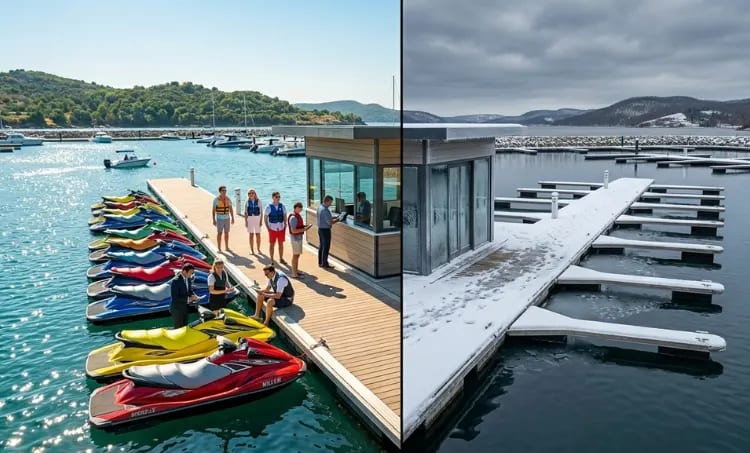

Visual representation of seasonal demand in a jet ski rental business
How much does it cost to start a jet ski rental business?
Jet ski purchase or lease costs
A new jet ski costs anywhere from $5,000 to $20,000, depending on the engine, body, and features. For rental purposes, mid-range workhorses hold up better than budget models.
For rental fleets, buying two to three-year-old models with under 100 hours is the typical smart buy. They cost 30 to 40 percent less than new and still have years of reliable use ahead. The risk is higher maintenance exposure, so always have a mechanical inspection done before purchase.
Leasing is available through some marine dealers, but less common for rental fleets. If capital is tight, it is worth exploring manufacturer financing through Yamaha or BRP (Sea-Doo) dealers.
Trailer, dock, storage, and fuel costs
Each jet ski needs a trailer for transport. Budget $1,500 to $3,000 per trailer for reliable used equipment. Storage runs $400 to $800 per month for a climate-controlled unit, depending on your market. If you secure a marina slip or dock arrangement, costs vary widely by location and whether the marina charges monthly or seasonal rates.
Fuel is an ongoing operating cost that catches new owners off guard. A single jet ski uses around $20 to $30 worth of fuel per hour of operation. At six hours per day across five units, that is $600 to $900 in daily fuel costs at peak season. Build this into your per-rental pricing, or you will watch your margins disappear.
Insurance, permits, and business registration
Business insurance for a small jet ski rental fleet runs $5,000 to $15,000 annually. Commercial marine liability insurance for a rental operation is fundamentally different from personal watercraft insurance. You need coverage that specifically covers renters using your equipment, not just owner-operated use. Providers like The Hartford and Global Marine Insurance Agency specialize in this.
A small operation with three jet skis typically requires $500 to $2,500 in permits and licensing, depending on your state.
Sources: jim.com
Website, booking, and payment setup costs
A functional website with booking integration typically costs $500 to $1,500 to build, and rental management software runs $50 to $200 per month on top of that. Payment processing adds 2.9% plus $0.30 per transaction on most platforms.
That said, if you want to keep things lean at the start, RentInno is worth knowing about. It is a rental management software that includes a built-in store where customers can browse your fleet and book online, so you are not paying separately for a website. There is a free plan to start with, which takes one variable off the startup budget entirely.
Sample startup budget
Here is a realistic budget for a three-ski starter operation:
Item
Low estimate
High estimate
3 jet skis (used, reliable models)
Trailers (3 units)
Safety gear (life vests, kill switches per ski)
Commercial insurance (year one)
Permits and business registration
Storage (6 months)
Website and booking software (year one)
Marketing and local advertising
Working capital (3 months operating)
Total
Sources: jim.com
Create a jet ski rental business plan
Set pricing and revenue targets
Start by researching what the two or three closest competitors are charging. Set your prices at or slightly above mid-market to avoid positioning yourself as the cheap option. Customers renting jet skis are not price-sensitive in the same way grocery shoppers are. They are buying an experience. Underpricing signals lower-quality equipment or service.
Build your revenue model around peak season occupancy targets. At $100 per hour for three skis running five hours per day across 90 peak-season days, your gross seasonal revenue is $135,000. From that, subtract fuel, insurance, storage, and staff to see your actual margin.
For a deeper look at how to build a pricing model that actually holds up, our pricing strategy guide for rental businesses covers the framework in detail.
Estimate cash flow and break-even timing
For most three to five ski operations, break-even on total investment comes somewhere between the end of year one and mid-year two, depending on how strong your first peak season is. The businesses that break even fastest are the ones that hit the ground with a working online presence, pre-season bookings already in the calendar, and at least one hotel or resort partnership driving consistent referrals before the season opens.
Licenses, permits, registration and insurance
This section matters more than almost anything else in your plan. Getting it wrong can shut you down or leave you personally liable for an incident that your insurance does not cover.
Form an LLC before your first rental. This structure protects your personal assets, like your home and car, from business debts and lawsuits, which is critical in a business with inherent physical risks. LLC registration costs vary, depending on your state. Open a dedicated business bank account at the same time and keep business and personal finances completely separate.
Watercraft and marina permissions
Every jet ski must be registered with your state's department of motor vehicles or equivalent watercraft registry. In most cases, you will also need a business license, a zoning permit, and a watercraft registration. You may also need a maritime transportation license and a pollution prevention certificate.
Contact your city or county clerk about a Commercial Use Authorization or Waterfront Operations Permit. If you are operating from a marina, the marina itself may have its own permit requirements and revenue-sharing arrangements. Get these conversations in writing before you commit to a location.
Liability insurance and coverage considerations
Commercial insurance for a jet ski rental business is fundamentally different from personal watercraft insurance. You need coverage that specifically addresses renters operating your equipment.
Key policies to have in place:
- Commercial general liability: Protects against third-party bodily injury and property damage. Minimum $1 million coverage is standard. Many marinas and venues require proof of this before allowing you to operate.
- Hull insurance: Covers physical damage to your jet skis from collision, accident, or mechanical failure during rentals.
- Inland marine insurance: Covers your equipment in transit between locations, not just at your registered address.
- Commercial auto insurance: If your truck or van tows the skis to the water, personal auto does not cover business-use accidents.
- Workers' compensation: Required in most states the moment you hire staff.
For broader guidance on coverage structure, our insurance guide for rental businesses covers what most operators miss until it is too late.
Source: Casey Insurance Companies
Safety training and waiver requirements
There is no single federal license for jet skis in the US. Requirements vary by state. Here is how some key markets break down:
State
Operator requirement
Florida
California
New York
Texas
As the rental operator, you are not required to supervise renters on the water in most states, but you are required to provide a safety briefing before each rental. Most rental companies do this through a mandatory video or in-person orientation plus a signed waiver. Waivers should be prepared by an attorney familiar with maritime liability in your state, not downloaded from a generic template site.
Choose the right location and fleet
Tourist destinations vs. local recreation markets
Coastal tourist markets like Miami Beach, Clearwater, and Myrtle Beach offer the highest revenue per day but come with higher permit costs, more competition, and seasonal spikes that are harder to sustain year-round.
Lake and reservoir markets near major metros, like Lake Tahoe near Sacramento, Lake Travis near Austin, or Lake Lanier near Atlanta, have lower peak-day revenue but more predictable local demand, easier permit environments, and often less direct competition. Some operators in interior markets report more consistent weekday bookings from corporate groups and local families who want a reliable nearby option.
The best way to evaluate a market before committing is to visit on a peak Saturday and count actual bookings at existing operators. If the nearest competitor has a line and a wait, the market can support you.
New vs. used jet skis
New jet skis
Used jet skis (2-3 years old)
Price range
Warranty coverage
Maintenance risk
Best for
Recommended models for a rental fleet
If you are buying new, these three models consistently show up in rental operations across the US:
Yamaha VX Cruiser starting around $11,299. Stable, comfortable for beginners, and parts are widely available.
Sea-Doo GTI SE 130 starting around $11,499. Reliable entry-level with intelligent brake and reverse, which reduces dock incidents.
Yamaha FX HO starting around $16,999. A step up in power and features for operators targeting experienced riders or tour groups.
If you are buying used, focus on models from 2021 to 2023 with under 100 hours. Avoid anything with more than 200 hours unless you have a trusted mechanic inspect it first.
Sources: JetDrift, PWC Trader
Fleet size for a first season
Three to five units is the right starting fleet for most new operators. Three skis give you enough capacity to serve multiple bookings simultaneously without overextending on capital. Five skis move you into meaningful volume without needing a full-time second employee to manage.
Do not buy more than five before your first season. You do not yet know your actual demand curve, peak hours, or which rental durations your customers prefer. One season of real bookings gives you that data. Use it to make your second-year purchase decisions.
Storage and maintenance considerations
Budget for proper covered storage. Jet skis left outside through the off-season deteriorate faster and cost more to service in the spring. A shared storage unit or rented warehouse bay is the most cost-effective option for a starter operation.
Establish a pre-rental and post-rental inspection routine from day one. Check fuel, hull condition, safety equipment, and engine function before every rental. Document it. This protects you legally if a renter claims damage they actually caused, and it catches small issues before they become expensive repairs.
Set up booking and daily operations
Online reservations and availability management
The majority of jet ski rental bookings today start with a Google search. If someone cannot find your availability and book a slot without calling you, you are losing business to whoever made it easier.
Your online booking system needs to show real-time availability, accept payment or deposits at booking, and automatically send confirmation emails. Manual booking through text messages or phone calls does not scale and creates double-booking risk that is operationally destructive during a busy weekend.
Digital waivers and customer check-in
A waiver signed on a clipboard at the dock is a liability management nightmare. Digital waivers sent before the rental date mean customers arrive pre-cleared, reducing check-in time from ten minutes per customer to under two.
More importantly, digital waivers are time-stamped and stored automatically. In a liability claim, that documentation matters. Our guide on preparing a solid rental agreement covers what needs to be in the document itself.
Payment collection and deposits
Collect a deposit at booking for any reservation made more than 48 hours in advance. This reduces no-shows significantly. Walk-up customers pay in full before launching.
Use a payment processor that saves card details for post-rental damage claims. Having the card on file makes charging for damages straightforward rather than confrontational.
Peak-hour scheduling and turnaround procedures
Your peak hours are typically 10 am to 4 pm on sunny weekends. Structure your rental slots to minimize dead time between bookings. A 55-minute rental window with a five-minute buffer for the next group's briefing allows twelve rental slots per ski per eight-hour operating day.
Brief each customer before launch, not during. A pre-recorded safety video playing in your check-in area while staff handles paperwork saves 5 to 7 minutes per booking, which adds up significantly across a full Saturday.
Fleet maintenance and inspection routines
Set a weekly service check in addition to the pre-rental inspection. Check oil, inspect the hull for damage, run the engine on the water before opening, and confirm safety equipment is in working condition. Log every check.
Schedule professional servicing at the start of each season and again mid-season for high-use units. Annual maintenance per ski runs $500 to $1,000 in routine costs. Budget for it rather than reacting to it. Our guide on the importance of rental product checks covers what a proper inspection process looks like.
Market your jet ski rental business
Define your target customers
Most jet ski rental customers fall into one of three buckets:
Vacationers and tourists who are visiting a coastal or lake destination and want a few hours of excitement. This is your highest-volume segment, but also the most weather and season-dependent.
Local recreational riders who know the waterway and come back regularly throughout the season. Lower acquisition cost because word-of-mouth does the work once you earn their trust.
Corporate and group bookings for team events, bachelor parties, and family reunions. These are larger per-booking revenue opportunities with better advance planning, making them operationally cleaner than walk-up rentals.
Each segment needs a different acquisition strategy. Tourists come through Google and resort partnerships. Locals come through referrals and local social media. Corporate comes through direct outreach and packages.
Local SEO and Google Business Profile
Your Google Business Profile is your single most important marketing asset. When someone searches "jet ski rental [your city]," your listing is what appears before your website in most cases.
Keep your profile updated with current photos, accurate hours, and an active review request process. Send a follow-up message to every customer asking for a review. A business with 50 recent reviews consistently outranks one with 200 older ones.
For a full setup guide, our post on Google Business Profile for rental businesses walks through the process step by step.
Hotel, resort, and tour partnerships
This is the highest-ROI marketing channel most new operators overlook entirely. A concierge at a resort hotel recommending your business to guests every day is worth more than any paid ad campaign.
Approach hotel activity desks, resort concierge teams, Airbnb hosts who cater to vacation rentals, and tour operators. Offer them a referral commission on every booking they send. Ten dollars per booking sent from three hotel partners during peak season generates significant volume with zero acquisition cost per customer.
Social media content and reviews
Instagram and TikTok are where jet ski rental businesses win customers. Short video of someone launching off a wave, a group of friends returning from a rental laughing, a sunset shot of the fleet lined up. These perform because they are visual and emotionally engaging.
Post consistently, use location tags, and respond to every comment and DM. The businesses with strong social presence in tourist markets get tagged by customers organically, which multiplies reach without additional ad spend.
Referral programs and repeat customer offers
Give every departing customer a reason to come back and to send someone else. A simple punch card, a 10 percent discount on their next booking, or a referral offer where both parties get a discount creates word-of-mouth momentum without high cost.
Common risks and how to reduce them
Accidents, liability, and insurance gaps
The most dangerous assumption new operators make is that their general liability policy covers everything. It often does not. Hull damage, renter-caused accidents, incidents on a public waterway, and damage occurring during transport all fall under different coverage categories.
Read every policy before you sign it. Specifically ask your insurer: Does this policy cover a renter who causes an accident while operating my equipment? If the answer involves any hesitation or conditions you do not fully understand, escalate to a marine insurance specialist.
Equipment damage and theft prevention
Install GPS tracking on every jet ski. This is both a theft deterrent and a liability protection measure. If a renter claims they returned the ski at 3 pm but the GPS shows it was still on the water at 4:30 pm, you have documentation.
Photograph the ski before and after every rental and send the after photo to the customer with their receipt. This creates a clear record that reduces damage disputes significantly.
Cash flow management during off-season months
The first winter after your first summer is when most undercapitalized operators hit a wall. Insurance, storage, loan payments, and website costs continue. Revenue does not.
Plan for this before your first season opens. Keep three months of fixed costs in reserve from your peak-season revenue. Do not reinvest everything into fleet expansion in year one. Wait until you have verified demand before scaling capital.
For a broader look at managing inventory and costs, this guide on effective rental inventory management covers the operational side in detail.
Scale the business
Add more jet skis
The right time to add fleet is when your existing units are consistently at 80 percent or higher utilization during peak hours and you are turning away bookings. Not before. Premature expansion is one of the leading causes of cash flow problems in seasonal rental businesses.
When you do add units, buy the same models you already operate. Standardizing your fleet reduces parts inventory, simplifies maintenance, and means any mechanic familiar with one unit can service all of them.
Offer guided tours or lessons
Guided tours are the single most underutilized revenue stream in jet ski rental. A one-hour guided eco-tour priced at $150 to $200 per person generates more revenue per unit than an unguided rental at the same duration, requires less wear because the pace is controlled, and appeals to customers who would not do a solo rental because they lack confidence.
Sunset tours, wildlife tours on calmer water, and beginner lesson packages for families with young children all extend your customer base beyond the thrill-seekers who are already looking for you.
Expand to additional waterfront locations
Once your first location is profitable and operationally stable with a manager in place, a second location becomes viable. Look for markets within two to three hours of your existing operation that share a similar customer profile but have underserved demand.
The operational template you built at location one, your booking system, waiver process, pricing model, and safety protocols, transfer directly to location two. This is where software that centralizes your operations becomes genuinely important. Managing bookings, availability, and inventory across two locations through separate spreadsheets is a recipe for errors.
Automate operations with rental management software
Every hour your staff spends on manual paperwork, phone-based booking, or tracking inventory on a clipboard is an hour not spent on customer experience or business development. As you scale, this overhead compounds.
Rental management software centralizes your booking calendar, customer records, payment tracking, and inventory status in one place, so you can see what is happening across your whole operation without being physically present.
RentInno is built for exactly this kind of operation. It handles real-time inventory tracking, online booking management, customer records, quotes, and contracts from one dashboard, without the complexity of enterprise software or the limitations of a generic booking tool.
Conclusion
A jet ski rental business is one of the more straightforward paths to a profitable seasonal operation, but it is not passive income, and it is not simple to execute well. The operators who thrive are the ones who treat it like a real business from day one: proper insurance, clean contracts, online booking, and a plan for what happens when a customer does not come back on time.
The startup costs are real; $40,000 to $85,000 for a three-ski operation is a meaningful commitment. The revenue potential is also real. A well-located, well-managed operation can generate $5,000 to $10,000 per month in season and compound that over the years as your reputation and customer base grow.
Start with the right location, the right insurance, and the right tools to manage your bookings and inventory. Build the system before you build the fleet. That sequence is what separates a business that sustains from one that scrambles.
Request a product demo
Get a demo and clarify your doubts about our software.